

Joshua Tree Experts in New Albany, OH> Tree Care
Tree Services in New Albany
Healthy Trees Across New Albany
Almost every tree in this community was put in the ground on purpose, in a row, as part of a plan somebody drew. That is what makes the streets look the way they do, and it is also why a single failing tree stands out so badly. One dead specimen in an allee of twenty is not a small problem here the way it would be in an older, more random neighborhood.
Our local crews and ISA-Certified Arborists spend most of their time on trees in exactly this situation: planted within the last thirty years, still filling out, and carrying the structural habits they picked up in their first decade. Correcting those habits now is cheap. Correcting them at forty feet is a crane rental.
Contact us and a member of our team will be in touch soon!
"The whole process was efficient from consult to job completion."
– Real Client Reviews
“Joshua Tree Experts transformed our yard! Their tree trimming service was professional, efficient, and left our property looking amazing.”
James C.“We had a hazardous tree close to our home, and their team safely removed it without any issues. Highly recommend their expertise!”
Sarah L.“Our trees have never looked healthier! The plant health care program really made a difference. Great service and knowledgeable team.”
Mark R.Tree Service Solutions for Every Situation
Planted landscapes need a different mix of work than old woods do: more structural correction, more attention to what is happening below grade, and the occasional hard call on a tree that was never going to make it. Here is what our crews handle.
Tree Trimming
Trees planted in a row have to be pruned as a set, or the row stops reading as a row. Our tree trimming in New Albany takes deadwood out, lifts the canopy to a consistent height over walks and drives, and corrects the competing leaders that show up in fast-growing nursery stock before they turn into permanent structural flaws.
Tree Removal & Stump Grinding
Some trees were planted too deep, in soil that was scraped down to subsoil during construction, and no amount of care brings them back. We handle tree removals in New Albany cleanly on manicured ground, grind the stump well below grade, and leave the site ready for a replacement that has a better chance than the original did.
Tree Cabling & Bracing
Ornamental pears and fast-growing maples planted in quantity during the building boom tend to develop the same weak union at roughly the same age, which is why they fail in groups after a wet snow. Installing cabling and bracing can buy a specimen tree another twenty years, and on a formal row that matters more than it would on a single back yard tree.
Tree Health Programs
Trees that went in as nursery stock carry problems that surface slowly: girdling roots, a root flare buried under mulch, compacted subsoil left over from grading. A seasonal health program puts a certified arborist on the property on a schedule, so those things get caught while they are still correctable rather than after the canopy has already thinned.
Tree Fertilizing
Construction grading strips topsoil off most new sites, and what gets spread back is often thin and compacted, which leaves planted trees hungry in ground that looks perfectly fine. Our deep-root fertilizing treatments inject a slow-release feed straight into the root zone below the turf, where the tree gets it and the lawn does not intercept it first.
Insect & Disease Management
Uniform plantings share pests the way a single crop does, so bagworms on one arborvitae hedge usually means the whole hedge, and Japanese beetles find the same lindens every July. Our pest and disease treatments begin with identifying what is actually feeding, then treating at the point in its life cycle where treatment does something.
Lightning Protection
Formal landscapes usually have one or two anchor trees that the whole design depends on, often standing alone on open lawn where they are the tallest thing for a hundred feet. lightning protection systems carry a strike safely down a copper conductor to ground, which is cheap insurance on a tree that cannot be replaced at size.
Arborist Reports
Associations, builders, and commercial property owners here often need something in writing: a condition assessment before a sale, documentation for a tree-replacement requirement, or an opinion for an insurance claim. Our arborist reports give you a defensible written evaluation of condition, risk, and recommended action, signed by a certified professional.

Commercial Tree Care
The business park, the school campuses, and the association common areas together hold more trees than most of the residential streets do, and all of them sit where people walk. Our commercial tree service covers scheduled pruning cycles, hazard inspection, removals, and storm response on a timetable that works around business hours and school schedules.
We schedule around lot use and event calendars, and we document every visit so a property manager has a record of what was inspected and when. For an owner with trees at several addresses, we will build one plan across the portfolio instead of quoting each site as though it were unrelated.
Emergency Tree Services
Open, exposed lots with young trees take wind badly, and a summer storm here can lay over a fifteen-year-old tree that looked perfectly healthy the day before. Our emergency tree services in New Albany clear the hazard, make the area safe, and haul off the debris so the property is presentable again quickly.
Professional Tree Service Throughout New Albany
The planted canopy here runs heavily to red and Freeman maples, honeylocust, callery pear, sweetgum, and rows of pin oak, with stands of older black walnut, hackberry, and cottonwood surviving along Rocky Fork and Blacklick creeks where the farms used to be. The pin oaks show the same yellowing between the leaf veins you see across this part of the county, because the soil runs alkaline enough to lock up iron they cannot reach. The pears are the bigger nuisance: planted by the thousand, beautiful for fifteen years, and then splitting apart at the base of the canopy in the first heavy wet snow after they get big.
Below all of it is graded ground. Most of these lots were farm fields a generation ago, scraped flat, built on, and then re-covered with a shallow layer of topsoil over compacted clay subsoil. Roots hit that pan and run sideways, which is why so many trees here are shallow-rooted, drought-sensitive, and prone to going over in wind despite looking healthy. Add the freeze-thaw cycle that works soil loose around those shallow roots each spring, and the summer straight-line winds crossing open ground with nothing to break them, and you have a canopy that needs structural pruning far more than it needs anything else.

Why Homeowners Rely on Joshua Tree Experts
Work on a planted landscape is judged by how it looks from the street the day after, and by whether the tree is still standing in ten years. We take both seriously.
ISA-Certified Professionals
A certified arborist makes the call on your property, not a crew leader looking at the next job. If a tree can be corrected with structural pruning or held together with a cable, that gets recommended before a removal does, and if it genuinely needs to come out we will tell you why in plain terms.
Local Experts Serving Ohio Properties
Our crews know how these subdivisions were built and what got planted in which year, which means they recognize a girdling root or a buried root flare on sight instead of treating the symptom above ground. That saves a lot of guessing and a lot of unnecessary removals.
Honest Pricing Without Surprises
The price is written down before the saws come out, with the scope spelled out line by line so nobody is arguing later about whether haul-off was included. If we open something up and find the situation is different from what we bid, we stop and talk to you first.
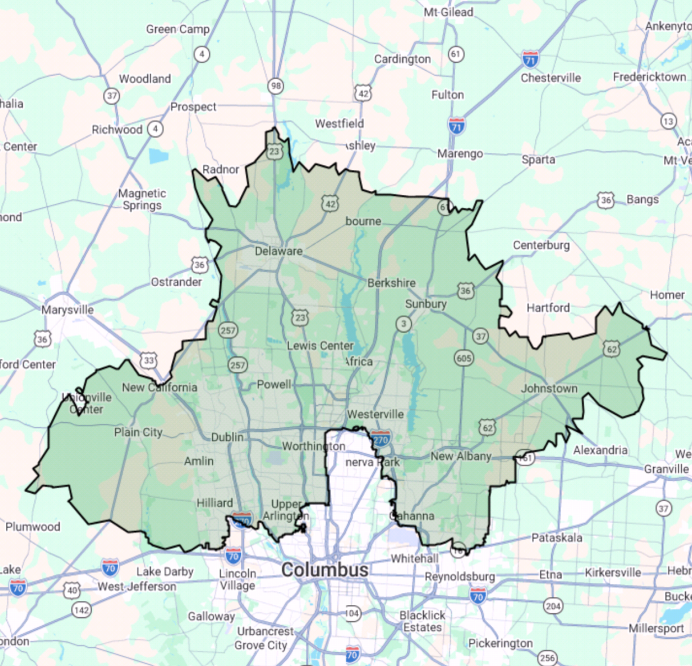
Serving Communities Surrounding North Columbus, OH
Talk With a New Albany Tree Service Expert Today
The quickest way to find out whether that thin-looking tree is dying or just hungry is to have somebody who does this for a living stand under it with you. We will walk the property, sort the trees into what needs attention now and what can wait a season, and leave you a written plan and price. The visit costs nothing and ends whenever you want it to.
Beyond Tree Care Services
The same local team can take care of the turf and the perimeter around the trees. Both programs launch with the new location.
Lawn Care (Coming Soon)
Lawns on graded clay here go to crabgrass in the thin spots every spring and then brown out fast in a dry August. Lawn care in New Albany is coming soon and will cover fertilization, weed control, grub treatment, and fall aeration with overseeding.
Pest Control (Coming Soon)
On big lots backing to creeks and open ground, mosquitoes and ticks hold in the shaded edges and ants work the foundation line all summer. Pest control treatments in New Albany are coming soon and stay exterior and perimeter only.
Answers to Common Tree Care Questions
Do I Need a Permit to Remove a Tree in New Albany?
+
On private residential ground the decision is usually yours, but two other layers apply here more often than they do elsewhere. Street trees in the strip between the sidewalk and the curb are municipal, and most of the neighborhoods here sit under an association with its own landscape standards and replacement requirements that are frequently stricter than the village code. We check both before we schedule anything and tell you what approvals are needed.
How Much Does it Cost to Remove a Tree?
+
Access drives the price as much as size does. A tree on open lawn with room for a truck is straightforward. The same tree tucked between a wall, a fence, and an irrigated bed has to come down in pieces on ropes, with everything protected underneath, and that is more time and more crew. Stump grinding, debris haul-off, and any lawn or bed restoration afterward all factor in. A short on-site look gets you an exact number.
What Are the Benefits of Tree Trimming?
+
For young and middle-aged planted trees, most of the value is in structure. Removing a competing leader at fifteen years costs very little and prevents the split that would take the tree apart at forty. Thinning also cuts the sail area the wind pushes against and improves airflow through the canopy, which helps with the leaf fungi that show up in humid summers. The tidier look is a bonus, not the point.
How Often Should I Trim My Trees?
+
Younger trees, which is most of what is planted here, do best on a two to three year cycle while their structure is still being set. Once a tree is mature and its form is established, three to five years is usually enough unless it stands over a drive, a patio, or a play area. Formal rows often go on a shorter cycle simply so they stay matched. An arborist can set the interval per group rather than per tree.
What Time of Year is Best to Prune My Trees?
+
Late winter is the best window for most of what grows here. The branch structure is visible without leaves, the tree pushes strong growth in response, and the insects and fungi that move disease into fresh cuts are still dormant. Oaks specifically should be pruned while dormant, since the beetles that spread oak wilt are active during the growing season. Broken and hazardous limbs are the exception and come out whenever you find them.
What Does Tree Fertilizing Include?
+
It starts with figuring out what the tree is actually short of, which on graded lots is more often air and root space than nitrogen. A deep-root application puts slow-release fertilizer into the root zone under the turf, where tree roots can use it, and the injection itself helps loosen compacted soil so oxygen gets down there. Where a specific deficiency is in play, like the iron chlorosis that shows up in pin oaks on alkaline ground, we treat that directly rather than applying a general feed.
Why Do My Trees Need Cabling?
+
Cabling addresses a structural weakness that no amount of pruning will fix, usually two stems of similar size joined at a tight angle with bark trapped inside the union. That connection never gets strong, and a heavy wet snow or a hard gust can split the tree down the middle. A cable set high in the canopy limits how far those stems can separate and takes the peak load off the joint. Compared with losing a mature specimen, it is inexpensive, and the hardware gets inspected on a regular cycle.
Interested in Becoming an Arborist?
If our tree, lawn, and pest services spark your interest in a career, explore our guide on how to become an arborist and get ready for the Certified Arborist exam with resources from Joshua Tree Experts.





Copyright 2026 Joshua Tree Experts. All Rights Reserved.