

Joshua Tree Experts in Greater Columbus, OH > Tree Care
Tree Services in Greater Columbus
Keeping Greater Columbus' Canopy Vibrant
Across the older neighborhoods there are thousands of very large trees planted between the wars, standing in tree lawns four feet wide with a house on one side and a street on the other. They give those streets everything that makes them desirable. They are also getting old at more or less the same time, which is a problem the whole city is working through at once.
Our local crews and ISA-Certified Arborists work these neighborhoods every week, and the advice changes considerably from block to block. A tree in deep river-bottom soil behaves nothing like the same species planted in tight compacted ground between a sidewalk and a driveway, and the care plan has to reflect that.
Contact us and a member of our team will be in touch soon!
"The whole process was efficient from consult to job completion."
– Real Client Reviews
“Joshua Tree Experts transformed our yard! Their tree trimming service was professional, efficient, and left our property looking amazing.”
James C.“We had a hazardous tree close to our home, and their team safely removed it without any issues. Highly recommend their expertise!”
Sarah L.“Our trees have never looked healthier! The plant health care program really made a difference. Great service and knowledgeable team.”
Mark R.Tree Service Solutions for Every Situation
Old trees in tight spaces, storm damage, and declining canopies are the three things we see most across the metro. Here is the range of work our crews handle.
Tree Trimming
Long limbs reaching out over roofs and streets carry more leverage than most homeowners realize, and deadwood in an old canopy comes down on its own schedule. Our tree trimming in Greater Columbus takes out the deadwood, reduces the weight at the ends of the longest limbs, and thins the canopy so wind moves through rather than against it.
Tree Removal & Stump Grinding
A hollow trunk, a dead top, or a tree that has simply outgrown a four-foot tree lawn eventually reaches the point where keeping it is no longer defensible. We handle tree removals in Greater Columbus in confined spaces with rigging and a crane where needed, then grind the stump well below grade.
Tree Cabling & Bracing
Silver maples and old Norway maples split at the union between two large stems more often than any other failure we see, usually under wet snow rather than in a summer storm. Installing cabling and bracing supports that union and can hold a valuable shade tree together for decades.
Tree Health Programs
Trees in confined urban soil decline gradually, losing a bit of canopy density each season, and by the time it looks obvious the tree has often been struggling for years. A seasonal health program puts a certified arborist on the property on a regular cycle to catch that early and treat what is causing it rather than what shows.
Tree Fertilizing
Between pavement, driveways, utility trenches, and decades of compaction, most city trees have far less usable root space than their canopy suggests, and nutrients sitting in that soil are not necessarily reachable. Our deep-root fertilizing treatments place a slow-release feed directly into the root zone below the turf and help loosen the soil in the process.
Insect & Disease Management
Scale builds quietly on maples until limbs die back, Japanese beetles work the lindens and crabapples in July, and borers move into any tree already stressed by drought or construction. Our pest and disease treatments begin with a correct identification, because the right material applied at the wrong point in the life cycle accomplishes nothing.
Lightning Protection
A tall old specimen standing close to a house is usually the highest point on the lot and the one thing on the property that cannot be replaced at size. lightning protection systems route a strike safely down a copper conductor to ground rods set away from the trunk.
Arborist Reports
City tree regulations, shared trees on a property line, insurance claims after a storm, and condition reports before a closing all call for documentation from somebody qualified to give it. Our arborist reports provide a written, defensible assessment of condition, risk, and recommended action.

Commercial Tree Care
Apartment portfolios, office buildings, retail centers, campuses, and institutional properties across the metro carry mature trees over parking, walkways, and entrances. Our commercial tree service covers inspection cycles, scheduled pruning, removals, and storm response on a schedule built around how the property operates.
We coordinate access and timing so work is not happening in the middle of your busiest hours, and each visit comes with written documentation for your records. For portfolios spread across several addresses, we put together one plan with a single point of contact instead of quoting each site independently.
Emergency Tree Services
When a storm drops a limb across a street, onto a garage, or into the power service, it has to be dealt with immediately and by somebody with the right equipment. Our emergency tree services in Greater Columbus get a crew out to make the area safe, remove what is hazardous, and clear the debris.
Professional Tree Service Throughout Northeast Atlanta
The older neighborhoods are dominated by silver maple, Norway maple, pin oak, red oak, sugar maple, and American sycamore, with London plane along some of the commercial streets and honeylocust filling the more recent street plantings. Silver maples are the workhorse and the problem: fast growing, planted everywhere in the middle of the last century, and built with weak wood and divided trunks that fail predictably once the tree gets large. Pin oaks show yellowing between the leaf veins across most of the metro because the soil runs alkaline enough to lock up iron. Ash has been effectively removed from the landscape by emerald ash borer, and dead ash that remains standing is brittle and hazardous.
Soils vary widely across the metro, from deep well-drained silt along the river corridors to the dense glacial-till clay that covers most of the rest, and in the built-up neighborhoods a century of construction and traffic has compacted whatever was there originally. The common result is limited oxygen at root depth, which shows as thin canopies, short annual growth, and slow drought recovery. Weather then supplies the stress test: summer straight-line winds and the occasional derecho, winter ice and heavy wet snow, and a spring freeze-thaw cycle that works soil loose around shallow roots. Pruning for wind and ice load ahead of the season is the most reliable protection available.

Why Homeowners Rely on Joshua Tree Experts
Anybody can sell a removal. Here is what we hold ourselves to instead.
ISA-Certified Professionals
A certified arborist evaluates the tree and writes the recommendation, not a salesperson working from the curb. A large old shade tree is worth a great deal to a property, so if pruning or a cable can keep it, that option gets presented and priced first.
Local Experts Serving Northeast Atlanta Properties
Our crews work across the metro week in and week out and know how conditions change from one corridor to the next, which species are failing together, and how storms tend to track. That produces accurate calls quickly and fewer surprises after the work starts.
Honest Pricing Without Surprises
You get a written price with the scope itemized before anything begins, cleanup and haul-off included. If we get into the tree and find decay that was not visible from the ground, we come down and talk it through with you before doing anything further.
Serving Communities Surrounding North Columbus, OH
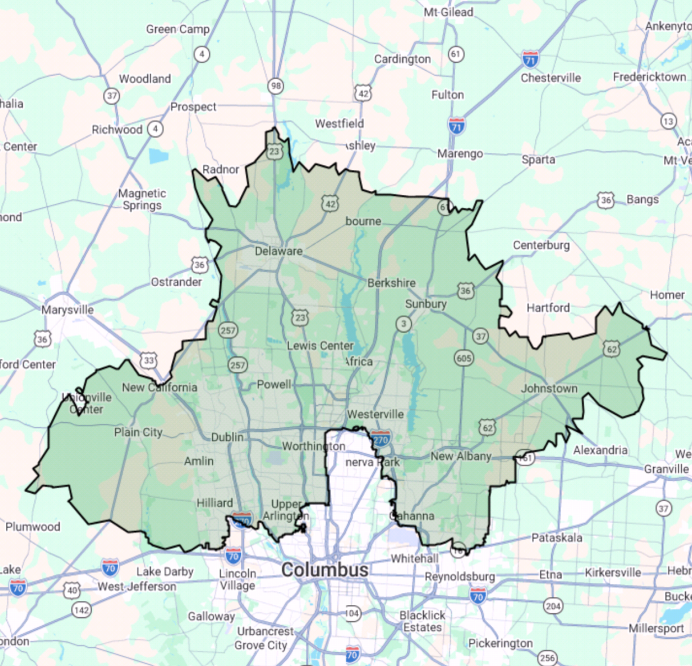
Talk With a Greater Columbus Tree Service Expert Today
If you have a large tree you are uneasy about, the most useful thing you can do is have somebody look at the parts of it you cannot see from the ground. We will assess the property, tell you what is urgent and what can wait a season, and leave a written plan and price. There is no charge for the visit and no pressure at the end.
Beyond Tree Care Services
The same local team can look after the lawn and the perimeter beneath those trees. Both programs launch with the new location.
Lawn Care (Coming Soon)
City lawns fight heavy shade under mature canopies, compacted soil, and a dry stretch nearly every August. Lawn care in Greater Columbus is coming soon and will cover fertilization, weed control, grub treatment, and fall aeration with overseeding.
Pest Control (Coming Soon)
Older housing stock on shaded lots gives ants, wasps, and spiders plenty of entry points, and mosquitoes hold in damp shade through the summer. Pest control treatments in Greater Columbus are coming soon and stay exterior and perimeter only.
Answers to Common Tree Care Questions
Do I Need a Permit to Remove a Tree in Greater Columbus?
+
That depends on which jurisdiction you are in, and the metro has a great many of them. The tree lawn between the sidewalk and the curb is nearly always public right of way and regulated by the municipality, while a tree fully on private ground is usually the owner's decision. Several suburbs add landmark tree or replacement requirements, and newer developments layer association rules on top. We confirm the rules for your specific address before scheduling and tell you if a permit is required.
How Much Does it Cost to Remove a Tree?
+
Size starts the estimate and access usually decides it. A tree in an open yard with truck access is straightforward; the same tree in a back yard behind a garage, over a deck, between two houses, or within reach of a service line has to be dismantled and lowered by rope, and sometimes needs a crane in the street. Stump grinding, debris haul-off, and protecting what is underneath all factor in. An on-site look is the only way to get a firm number.
What Are the Benefits of Tree Trimming?
+
On a mature tree in a built-up neighborhood, the main benefit is risk reduction. Removing deadwood and shortening overextended limbs takes away what is most likely to fall and reduces leverage on the rest. Thinning lowers the wind resistance of a dense canopy and improves light and airflow, which helps with the foliar diseases that turn up in humid summers. It looks better as well, but that is not the reason to do it.
How Often Should I Trim My Trees?
+
Three to five years is a workable cycle for most mature shade trees here. Large old silver maples and anything standing directly over a house, garage, or sidewalk often deserve a shorter interval, since deadwood accumulates quickly and a single failure at that size is expensive. Young trees want lighter, more frequent attention every two to three years while their structure is being established. An arborist can set the schedule tree by tree.
What Time of Year is Best to Prune My Trees?
+
Late winter before bud break is the best window for most species in this area. The structure is visible without leaves, the tree responds with strong spring growth, and the fungi and insects that spread disease through fresh cuts are dormant. Oaks should be pruned during dormancy in particular, because the beetles that move oak wilt are active during the growing season. Dead, broken, or clearly hazardous limbs come out whenever you find them.
What Does Tree Fertilizing Include?
+
We begin by working out what is actually limiting the tree, which in compacted city soil is usually availability and oxygen rather than a straightforward nutrient shortage. A deep-root application injects slow-release fertilizer into the root zone beneath the turf where the tree can reach it, and the injection helps open tight soil at the same time. For the iron chlorosis so common in pin oaks on alkaline ground here, we treat that deficiency specifically rather than applying a general feed.
Why Do My Trees Need Cabling?
+
Cabling supports a structural weakness that pruning alone cannot fix. The usual case is two stems of similar size joined at a tight angle, with bark trapped inside the union so the connection never gains real strength, and silver maples across the older neighborhoods are full of them. Enough wind or wet snow splits the tree there, often dropping half of it onto whatever is below. A cable installed high in the canopy limits that movement and takes the peak load off the union. It is far cheaper than losing the tree, and the hardware gets inspected on a regular cycle.
Interested in Becoming an Arborist?
If our tree, lawn, and pest services spark your interest in a career, explore our guide on how to become an arborist and get ready for the Certified Arborist exam with resources from Joshua Tree Experts.




Copyright 2026 Joshua Tree Experts. All Rights Reserved.