
Boxelder Bugs in the House: Why They Come Inside & How to Stop Them
It’s the middle of winter, the furnace is running, and yet there’s a red and black bug crawling up your living room window. Then another one shows up on the curtains. If you live along Colorado’s Front Range or Utah’s Wasatch Front, you’ve almost certainly met the boxelder bug.
Boxelder bugs are one of the most common fall and winter nuisance pests in the Mountain West. They don’t bite, they don’t damage your home, and they don’t breed indoors, but they show up by the dozens, stain fabrics, and smell unpleasant when crushed.
This guide explains what boxelder bugs are, why they end up in your house, what to do about the ones already inside, and how to keep them out next year.
What are boxelder bugs?
According to Colorado State University Extension, adult boxelder bugs are about half an inch long and black, with three red lines just behind the head, a red line along each side, and a red diagonal line on each wing. Young boxelder bugs, called nymphs, are smaller, wingless, and bright red.
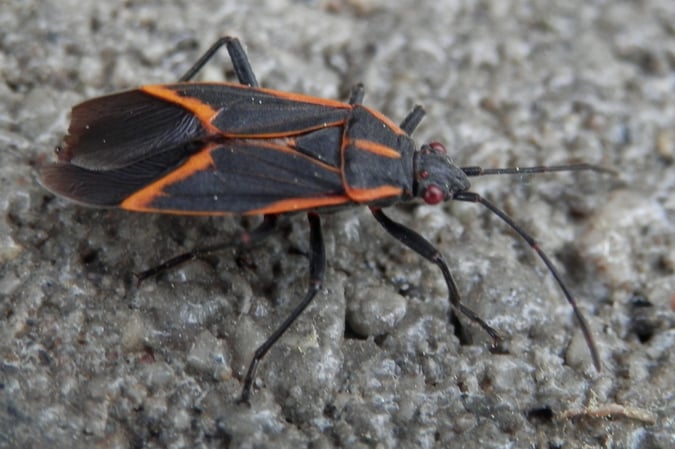
Utah has a close relative, the western boxelder bug. It looks very similar, though New Mexico State University notes it is generally less of a household nuisance than the common boxelder bug.
The name comes from their favorite food. Boxelder bugs feed mainly on the seeds of boxelder trees, a fast-growing maple that’s common across the Mountain West. CSU Extension points out that the seed pods grow only on female boxelder trees, and the bugs seldom build up to nuisance numbers unless a female boxelder is somewhere in the neighborhood. Utah State University Extension adds that they can also feed on maple, ash, and fruit trees.
Why do boxelder bugs come inside?
Boxelder bugs spend the winter as adults, and they need a protected place to do it. In nature, that might be a crack in tree bark or a gap under a rock. In a neighborhood, the best options are usually the walls of your house.
The process starts in late summer. In Utah, USU Extension reports that adult boxelder bugs commonly gather on buildings in August and September, especially on south-facing sides. As the weather cools, they cluster on sunny walls, foundations, and rocks to soak up warmth, then squeeze into any opening they can find.
CSU Extension notes that they settle into cracks and crevices in walls, doors, under windows, and around foundations, particularly on south and west exposures. Many end up behind siding or inside wall voids.
That’s where the indoor problem begins. Through the winter, those bugs sit quietly inside your walls. On warm, sunny days, they wake up and start moving toward the warmth and light. Some find their way out through gaps around outlets, baseboards, window frames, and light fixtures, and suddenly they’re on your windows and curtains. That’s why you can see boxelder bugs indoors in January, months after they first moved in.
Is it a boxelder bug or an elm seed bug?
In Utah and western Colorado, there’s a newer look-alike: the elm seed bug. It was first confirmed in Utah in 2014 and is now widespread along the Wasatch Front, according to USU Extension.
The easiest way to tell them apart is timing. Elm seed bugs are a summer pest, peaking from mid-June through August, while boxelder bugs are the problem in fall and winter. Elm seed bugs are also a bit smaller than boxelder bugs, have a red underside, and give off a strong odor some people compare to bitter almonds. Fortunately, the steps that keep boxelder bugs out work for elm seed bugs too.
The boxelder bug year at a glance
Knowing the boxelder bug’s yearly cycle tells you exactly when to act. Here’s how a typical year plays out in Colorado and Utah:
- Spring: Adults that spent the winter in buildings head back outdoors. According to CSU Extension, when tree buds open, females lay small red eggs on the leaves and bark of female boxelder trees.
- Summer: The eggs hatch into bright red nymphs that feed on low plants near the trees, then move up to the seeds as they form. Over the summer, they grow into winged adults.
- Late summer and early fall: Adults leave the trees and start looking for winter shelter, gathering in large groups on sunny walls. This is the window when sealing and exterior treatments do the most good.
- Winter: The bugs hide inside walls and other protected spaces, waking up and wandering indoors on warm, sunny days.
If you’re dealing with boxelder bugs indoors right now, the cycle is also good news: the problem won’t last forever, and you have all spring and early summer to get your home ready before they come back.
Are boxelder bugs harmful?
For the most part, no. Boxelder bugs are a nuisance pest rather than a dangerous one. USU Extension notes that they rarely cause economic, aesthetic, or structural damage. Here’s what you can expect:
- They won’t damage your home. Boxelder bugs don’t chew wood, wiring, or insulation.
- They won’t multiply indoors. CSU Extension confirms that boxelder bugs do not reproduce while they’re overwintering. The bugs you see in winter are the same ones that moved in during the fall.
- They can stain. Their droppings can leave small reddish-orange spots on curtains, walls, and other light-colored surfaces.
- They smell when crushed. Squishing a boxelder bug releases an unpleasant odor and can leave a stain.
- Bites are very rare. CSU Extension notes that boxelder bugs have been reported to bite people only on rare occasions. They aren’t known to spread disease.
- Your houseplants are safe. They may probe houseplants looking for food, but CSU Extension says they don’t cause damage.
Outdoors, boxelder bugs do little harm to the trees they feed on. Their feeding can occasionally leave small dimples on fruit, but it’s rarely a real problem.
What to do about boxelder bugs already inside
If boxelder bugs are already in your house, the goal is to manage them until spring while you plan to keep them out next year.
- Vacuum them up. CSU Extension recommends a vacuum as the best way to deal with bugs indoors. It’s quick, doesn’t leave stains, and avoids the smell of crushed bugs. Empty the canister or bag outside right away, or seal it in a trash bag, so the bugs don’t crawl back out.
- Don’t squish them. Crushing boxelder bugs on curtains, walls, or carpet is the fastest way to end up with stains and odors.
- Find where they’re getting in. Bugs inside your walls make their way into living spaces through gaps around window frames, baseboards, electrical outlets, light fixtures, and ceiling vents. Notice where they keep appearing, and seal those gaps with caulk.
- Skip the bug bombs. Household insecticide sprays can kill individual bugs on contact, but CSU Extension notes they only provide temporary relief. Foggers won’t reach the bugs hiding in your walls, so more will keep emerging on warm days.
- Be patient. Boxelder bugs will keep showing up on sunny winter days, but the problem has a natural end. According to CSU Extension, indoor infestations should be over by late May, when the bugs have either died or returned outdoors to their host trees.
If you still see big groups gathering outside on warm afternoons, a mix of laundry detergent and water sprayed directly on the bugs will kill them. CSU Extension calls this a cheap, safe, and effective option, with two catches: it only works on bugs it hits directly, and it can damage plants, so keep it off your landscaping.
How to keep boxelder bugs out next year
CSU Extension is clear on one point: once boxelder bugs are inside your home, control becomes much more difficult. Prevention is where you’ll get the best results, and timing is everything.
Seal up your home by midsummer. In Utah, boxelder bugs start gathering on buildings in August, and along the Front Range they’re looking for winter shelter by early fall. Plan to finish sealing before they arrive. Focus on the south and west sides of your house, where the bugs gather most:
- Caulk cracks in the foundation and gaps around windows and door frames.
- Seal openings where plumbing, gas lines, electrical conduits, and cable lines enter the house, as USU Extension recommends.
- Add or replace weatherstripping around doors and windows, and install tight-fitting door sweeps.
- Repair torn window screens and make sure attic, soffit, and dryer vents are screened.
- Check gaps where siding meets the foundation, trim, or roofline.
Consider a professional perimeter treatment. When boxelder bugs begin gathering on your home in late summer, a pest control professional can treat the areas where they rest and enter, such as foundations, window and door frames, vents, and eaves. CSU Extension notes that many over-the-counter exterior insecticides aren’t very effective against boxelder bugs, so timing and product choice matter. A treatment works best as a companion to sealing, not a replacement for it.
Think about nearby boxelder trees. CSU Extension calls removing female boxelder trees the most permanent solution, though it admits that may not be practical or desirable. Boxelder bugs tend to overwinter close to the trees they feed on, so if a female boxelder sits right next to your house, it’s likely the source. An arborist can help you identify female trees and weigh whether removal makes sense, especially if the tree also has structural or health problems.
Get help with boxelder bugs from Joshua Tree Experts
Boxelder bugs are harmless, but they’re a real nuisance when they show up on your windows all winter. For now, vacuum up the ones you see, avoid crushing them, and take note of where they’re getting in. Then make a plan to seal those gaps before they return next fall.
If you’d like professional help, Joshua Tree Experts serves homeowners across Denver, CO and Salt Lake City, UT, along with communities nationwide. Our team can treat your home’s exterior at the right time of year and help you find and close entry points. Call us at 833-583-8733 or schedule a quote today.